

The new Deaf President Now! film is now streaming on Apple TV+. Co-directed and produced by Nyle DiMarco, this documentary gives the hearing world rare insight into what happened during that historic week in 1988, when Deaf people stood up to a hearing Goliath and demanded the right to lead themselves.
As a Deaf ASL user, the DPN movement isn’t just history to me—it’s lore. I’ve known the facts, the faces, and the feelings behind it for more than 30 years. I know this story like I know the directions to my childhood home… which is why I was so surprised when the film still managed to teach me something new.
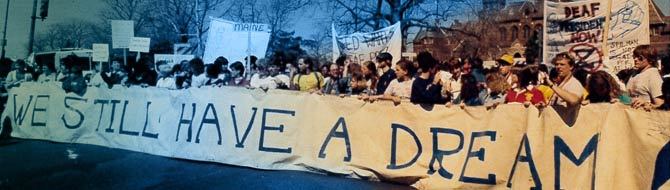
For a quick recap, DPN was the 1988 civil rights movement where Gallaudet students shut down campus and won the appointment of the first Deaf president. One of the most powerful civil rights victories in American history — and almost 40 years later, I’m still learning about it… and about myself as a Deaf person.
What Surprised Me Most About the New Deaf President Now! Movie
If you know the facts of DPN, you know the students were successful in their demands and I. King Jordan became the first Deaf president of Gallaudet University. I assumed he would be the central figure here—the hero of the story. He wasn’t. Not in the way I expected. There was so much more happening beneath the surface.
The true focus is on the students, both then and now. Told through real news footage and present-day interviews, the story flows together beautifully. I was transfixed and transported back to another time—1988—when I was still in high school, not yet aware of the empowered Deaf world that awaited me. These students were fighting for the change that would shape their world and mine.
But they didn’t set out to become warriors. Or leaders. And maybe that’s the first thing that surprised me.
The Missing Content I Never Knew
How it all came together surprised me. These students weren’t some elite crew that showed up together and got everyone rolling as a group. Some groups of young people do that, which is fine. But that’s not what happened here – at all.
The four primary leaders weren’t even really friends—they were simply the ones moved to act. They stepped into the roles they saw were needed, and jumped – piecing together strategy as they went. Even if they didn’t agree or love what the other represented or said – they had their eye on the common goal, even if it meant sacrificing their own personal glory. It was like watching a higher calling, with each reaching into the depths of their beings (whether they knew it or not) and stepping into their place in the collective light.
Now, I don’t know about you, but looking at this through my 50+ year old eyes, this was so brave of these young people!
This wasn’t a polished civil rights machine. It was raw, urgent, and utterly human.
The Moments That Hit Me Harder Than Expected
I’ve been Deaf my whole life, yet I didn’t step into my Deaf identity until college. I grew up knowing some ASL but rarely used it and had very few Deaf role models. I was always swimming my best in a hearing world, trying to fit in.
When I reached college, everything shifted. It sounds cliched, but I found my people, you know? Deaf peers, teachers, administrators and loads of other Deaf role models helped me realize I wasn’t defective, but a part of an incredible group. Not just for social-emotional purposes, but not having barriers allows one’s value and true talents to surface so they can be applied to one’s life and place in the greater society. Seeing and experiencing Deaf leadership in action is an essential part of that and to us as Deaf people. And that was the key thing missing from my life before it. How could I have felt personal empowerment when I saw that hearing people were always the ones in charge of Deaf people?
Watching the film brought back the shadow of those early years—the smallness I often felt. Not because people were unkind, but because of the attitudes embedded in the systems around me – and the hearing people in charge. The assumptions about what was “possible” for me through hearing eyes. The way access in general was treated like a favor instead of a basic human right. The 80s feel like a lifetime ago and the footage used proves that it wasn’t just my own personal growth that overcame so much, it’s how Deaf people were treated at the time that was so different – even at Gallaudet.
The smugness of the hearing board in the documentary—their paternalistic glances, their dismissive tone—was infuriating and called up a lot of familiar memories.
And the initial hesitation of I. King Jordan was fascinating. He was thinking like a hearing person, because once upon a time, he was one.
Having lost his hearing in an accident meant he had internalized the idea that his job was to “overcome” something. That mindset perhaps quietly shaped how he as a Deaf person was used to navigating hearing authority.
Luckily, he figured that out… and everything changed. He eventually aligned fully with the Deaf protesters, risking his job and livelihood.
So, he did become a hero—just not the hero I originally expected. His transformation is what makes him remarkable. DPN forced him to decide who he was and to claim that identity. That’s the real triumph.
What the Film Revealed About My Own Deaf Identity
Even after 35+ years in the Deaf community, this film reminded me that Deaf identity is not a straight line — it’s more like a puzzle.
One of the student leaders in the film comes from a Deaf family. After seeing the protest on the news, his dad calls him on the TTY — not to cheer him on, but to tell him to behave, to stop stirring things up. His father had lived his entire life under the weight of hearing expectations. He had learned not to push back-just take it. The son recognized that’s how his dad managed to survive – and said nope.
That struck me deeply. His father’s reaction felt so familiar. It reminded me that no matter where we come from as Deaf people — we share one undeniable experience:
We know what it feels like to be systematically disempowered.
Not because we are defective, but because hearing society is unable or unwilling to truly see us as equal.
But not all of us choose to fight it. We pick our battles. We survive the world we’re handed. Both groups understand the starting point, though. We’re both Deaf.
This movie reminded me that every Deaf person’s story matters. Every story adds a patch to the collective quilt. And watching this film made me remember that my square is sewn in there, too.

Why This Movie Matters Now
Because…
Hearing institutions still repeat the same patterns.
Deaf leadership is still fought for — not given.
Younger Deaf generations deserve to inherit context, not just crappy bare minimum access.
We take DPN for granted today, but the mountain those students climbed was massive. AND LOOK WHAT THEY DID!
This film is so important – it’s a blueprint for the next generation.
Final Thoughts
Nothing about us, without us – ever again. Future generations will make sure.
And this movie shows why this will always matter.