

Sign languages are not universal—they develop naturally within Deaf communities around the world.
This often surprises people at first–even ASL students. But just like English, Spanish, or Japanese, sign languages develop naturally within communities. That means American Sign Language (ASL), British Sign Language (BSL), Japanese Sign Language (JSL), and others are all distinct languages with their own grammar, vocabulary, and cultural context.
So what happens when Deaf people from all over the world gather?
That’s where International Sign (IS) comes in. International Sign (sometimes referred to as “International Sign Language”) is used in international Deaf spaces where many signed languages come together.
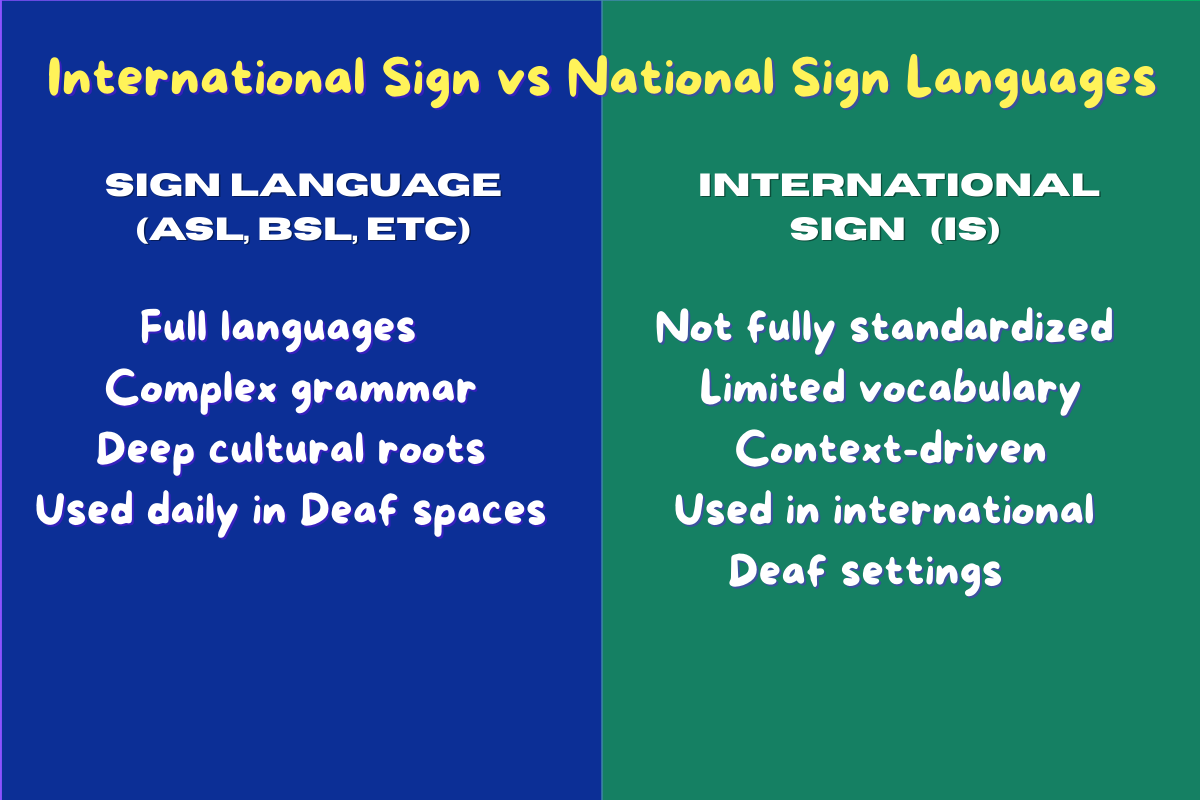
What Is International Sign Language?
International Sign (IS) is not a full language like the native sign languages of each country. Instead, it is best understood as a contact variety. It’s a flexible communication system that is utilized when signers from different (international) signed language backgrounds interact.
International Sign was not formally invented at a single point in time. It emerged naturally as Deaf people from different countries began interacting more frequently, especially after the founding of the World Federation of the Deaf in 1951.
IS draws from:
- Shared visual concepts
- Iconic signs (signs that “look like” what they mean)
- Common patterns across multiple sign languages
- Gestures and spatial strategies
Because of this, IS has:
- No single standardized grammar
- A limited and evolving vocabulary
- Heavy reliance on context and visual clarity
It’s important to note that International Sign is not typically learned or memorized as a fully standardized language in the same way as ASL or BSL. Instead, it combines commonly recognized signs, shared visual strategies, and flexible adaptation between signers.
Where and Why Is International Sign Used?
International Sign is typically used in global Deaf spaces where many signed languages meet.
You’ll often see IS used at:
- World Federation of the Deaf (WFD) events
- World Association of Sign Language Interpreters (WASLI) conferences
- The Deaflympics
- International Deaf youth camps and leadership programs
- Events at universities like Gallaudet hosting Deaf international visitors
In these settings, IS serves as a bridge. It facilitates communication without requiring everyone to know the same national sign language.
IS is especially useful for:
- Short-term interactions
- Presentations to diverse audiences
- Networking and social connection
International Sign vs. National Sign Languages
International Sign is NOT a replacement for countries’ native sign languages.
Each country (or region) has its own natural sign language, such as:
- ASL (United States & parts of Canada)
- BSL (United Kingdom)
- Auslan (Australia)
- JSL (Japan)
These national sign languages are complete, fully developed languages with:
- Complex grammar
- Rich vocabulary
- Deep cultural roots
In contrast, International Sign is:
- More simplified
- More situational
- Less precise
A Helpful Comparison for Hearing Learners
For hearing people, the closest comparison might be how people from different countries communicate using simplified English.
When people don’t share the same first language, they often:
- Slow down
- Use simpler vocabulary
- Rely on gestures
- Adjust to each other
That doesn’t create a new language—it’s a shared adaptation in real time.
A constructed international language like Esperanto was actually designed to serve as a universal spoken language, but most people never adopted it widely. Instead, people rely on adapting existing languages in the moment.
International Sign works in a very similar way—but visually.
Why Deaf People May Adapt Easily to International Sign
Most Deaf people who are fluent in their country’s sign language are already:
- Bilingual or multilingual
- Experienced in navigating different communication styles
- Skilled at using visual context and adaptation
Because of this, Deaf people are often highly flexible in multilingual environments.
International Sign is one example of that adaptability—but it’s not something most people formally “study.”
It’s something they develop through experience.
Skilled users of International Sign often develop greater fluency through exposure to international Deaf spaces rather than through formal study alone.
Should You Learn International Sign?
For ASL students, your goal should not be to go out and learn International Sign as another language. That is, unless your international travel plans naturally present these opportunities, but learning ASL or national sign languages fluently should come first.
Instead, aim to:
- Understand that sign languages are diverse—not universal
- Recognize how Deaf people communicate across differences
- Appreciate the global Deaf community
If you ever do find yourself in an international Deaf setting, just focus on clear signing and strong visual communication. Don’t worry about being perfect. Just be open.
Final Thoughts
International Sign shows us something really powerful.
Language barriers in a visually accessible space are easy to navigate–for Deaf people. We’ll always find ways to connect and communicate.
More than just a linguistic flex, IS is an example of our global Deaf communication in action. Some may see it a a “superpower”. To me, it’s far more indicative of the natural abilities that develop in Deaf people. And yes, some of these can be superior to those in hearing folks.
Psst, try not to act too surprised.
You are, of course, free to marvel.
Understanding what IS is and why it exists will give you a deeper appreciation for ASL as well as the adaptability of the worldwide Deaf community. May this encourage students to go out and experience Deaf culture, internationally.