
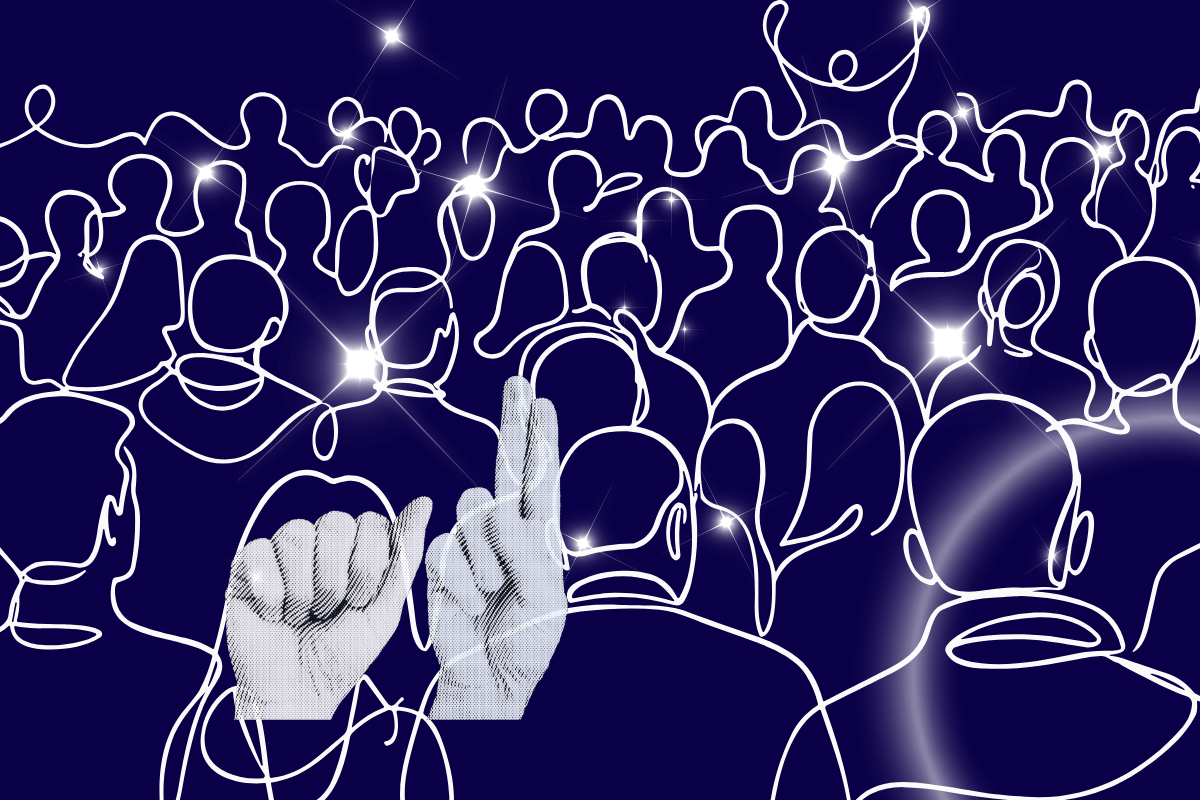
As a Deaf person, my everyday perspective gives me a chance to appreciate what Deaf people have overcome historically. For every person I meet that signs to me in ASL, every parent of a Deaf child who asks me about my experience… I know we’ve been heard. Because of that, I’m attuned to this type of issue within adjacent disabled communities. Lately, a lot is happening right outside my window in the autistic community. I can’t ignore it.
Autistic adults have alleged harm by a popular intervention geared toward autistic children: Applied Behavioral Analysis, or ABA. According to the Autistic Self-Advocacy Network (ASAN), autistic people object to this type of intervention because ABA is focused on making autistic people seem more “normal” or “less autistic,” using rewards and punishments to train autistic people to act non-autistic. ASAN says ABA and other therapies with these goals can hurt autistic people and don’t teach them the skills they actually need to navigate the world with their disabilities.
And yet I’ve observed an uptick in parents mentioning ABA, praising the service. A well-known physical/speech/occupational therapy chain in my community recently sprouted a shiny-new “ABA” arm, cheerfully sitting alongside its sister business. I even saw someone at a gas station wearing this ABA-business logo on a t-shirt. ABA-fandom has the floor–drowning out autistic adults who say they were harmed by it.
As a Deaf person who uses American Sign Language, this all seems really familiar to me.
What Deaf History Can Teach Us About Disability Interventions Like ABA
Deaf history shows what can happen when the people designing and recommending interventions define the problem from outside of the disability. The people who live with the outcome aren’t considered, even when they can offer the best feedback on how it’s working from inside the model.
It’s important to distinguish between interventions which aim to solve the problems of:
“How do we help this child function in the world?”
and
“How do we help this child function more like people without this disability?”
They are not the same.
Ultimately, which question you are asking will determine what the problems are to solve.
Historically, those who are inside of it and those who are outside of it are responding to very different problems.
Oralism and the History of Speech and Hearing Interventions for Deaf Children
In Deaf history, the introduction of Alexander Graham Bell’s Oral Method and the subsequent Milan Conference in the 1880s played an influential role in the eventual oppression of sign languages worldwide for over a century in favor of teaching deaf children to speak and listen via hearing devices.
As such, speech therapy and audiological visits are common appointments in a Deaf child’s life. The goals are speaking and hearing more. To be successful and essentially “overcome deafness,” you must speak and hear to some degree. Some children receive both of these services in schools, making them a constant presence or requirement. And yet, many Deaf people experience language deprivation due to their limited access to it–the very thing these methods should deliver. Instead many Deaf children lost out, big time.
These priorities leave many parents clueless. By restricting access to ASL or the Deaf community, a child may not receive all the building blocks for life. The thing is, you can’t really tell from the outside.
My Own History as a Deaf person
Take me, for example. Despite a hearing-like speech and facade, I was always on the fringe of understanding growing up. I never had a full complete picture of anything. But you only know what you know, so I actually didn’t realize everything I was missing. So, imagine my shock once I got to college and found myself immersed in ASL and the Deaf community. For the first time in my life, I discovered total clarity, access, peerage, confidence, and.. freedom in being able to focus on life and learning, not just on working hard to get a glimpse of what was going on in a world designed differently than I was. So, it was a relief and a revelation to say the least. But I was angry, too.
Why couldn’t I have had access to all this before? Why did it take 18 years to find the tools I needed to be successful?
The question is: How did we allow speech and hearing services gain such pervasive access to deaf children, convincing parents and schools that this was the answer? Even when it stood in the way of true access to learning?
The parents/professionals/people outside of the child cannot be the only ones measuring the outcome. Disabled adult involvement is critical.
What Happens When Deaf Adults Say We Experienced it Differently?
Deaf adults try to explain this to new parents with Deaf children, what we wished our parents knew back then. And yet, the parents-of/professional view tends to be absorbed first, with new parents clinging to hope centered on a service. An intervention.
This is what I see happening now within the autistic community, especially regarding ABA services and the ever present view that autistic children must spend a large chunk of their childhood receiving therapy that adults that went through it as children say harmed them.
What is this phenomenon and why does this happen? How do we (however unintentionally) value experts over a person’s lived experience?
Why Do We Trust Professionals Over Disabled Adults?
(A working theory)
A parent who looks and sounds like another parent:
“XXX worked. XXX changed our lives.”
The public accepts this.
A professional, an *expert* on XXX:
“XXX works. I’ve seen tremendous progress in clients.”
The public accepts this.
An X adult, treated with XXX as a child:
“XXX harmed me.”
The public challenges us.
“Oh, XXX is different now.”
“That wasn’t good XXX.”
“Every child is different.”
“You can’t speak for everyone.”
Why doesn’t the first-person testimony have equal power in this conversation?
The Problem Begins With Who Defines The Problem
People inside the disability and those outside of it tend to define and respond to the different features.. well, differently. Deaf people, for example, tend to have less clinical responses:
Kid’s deaf and doesn’t speak?
Well, that’s pretty normal. Sign! Learn ASL.
Meet other Deaf signing kids, get involved in the community.
Kid flushed their hearing aid again?
Ugh, yeah, it happens a lot. Meanwhile: SIGN!
Learn ASL. Down the road you’ll be able to come up with a plan on how they’ll use the hearing aid, but you all should be able to discuss it together.
Kid doesn’t want to wear their Cochlear Implant?
Well, it could be a million reasons. I hated mine as a kid, too. Look at this and this.
Meanwhile: SIGN! Learn ASL.
Language Deprivation waits for no one.
This is Why the ABA Issue Hits Home
I have this habit of taking someone’s word for it. When they tell me who they are, or what happened to them, I take their personal stories as truth. I have no reason not to, until I have a reason, you know? And to see similar stories by groups of people saying this collectively happened to them, I can’t ignore that.
The similarities between the Deaf and Autistic communities are striking. With explanations of interventions aimed at parents who only want the best thing for their disabled child, yet steered away from the testimonies of those who lived through it and are alleging harm, I can’t ignore that either.
Autistic adults say they were harmed by ABA as children. Please don’t ignore that.
Listen Before You Intervene
Very few people with Deaf or Autistic children get this kind of information unless they go digging for it here in the grassroots forest.
Professionals are the ones that diagnose and professionals are the ones that make their recommendations-–to other professional organizations.
Parents, listening to the professionals and other parents who also listened to professionals and see the socio-normative results they want may never connect with adults who have the same diagnosis as their child and have something different to say than the professionals with whom they’ve placed all their child’s proverbial eggs.
And only later the parents may learn how that felt to the child, from their own adult child.
Disabled Adults Need to Be a Voice in Deciding How to Work With Disabled Children
Why? How did this become the system? Could it be because…
Expert marketing overpowers disabled adult voices.
The lived experience doesn’t lead to a billable medical service in an ecosystem.
Bingo.
Hope is not a service.
Please listen to people with the most experience.
The people that live the life your child does.
This is my observation as a Deaf person with decades spent living and working within the Deaf community. For over a hundred years my community struggled to be heard by the larger community who made far too many decisions for us, without us.
My two cents from someone with lifelong skin in the game, if that matters. I hope it does.
First-person autistic resources:
Autistic Self-Advocacy Network (ASAN)
The Autistic Advocate (Kieran Rose)