

Deaf Awareness events are held on certain established days, weeks or months with the celebratory purpose of raising public awareness about Deaf Culture and people. That is, Deaf people who embrace the use of sign language and enjoy a life within the Deaf community and culture.
In the US, a cluster of dates in the Spring and Fall bring a flurry of activity in and around Deaf communities as well as on social media. These events include but are not limited to: festivals, public performances, gatherings, social media posts and campaigns. The common purpose of Deaf Awareness is to highlight Deaf causes, the use of sign languages and/or honor dates of historical significance for Deaf people.
Deaf Awareness days are also an opportunity for access. Not just for Deaf people, but for hearing people to be given access to a population of people within their own community with a shared language and culture all its own.
Deaf Awareness can lead to better connections with increased understanding in the larger community as well as seeds planted with tomorrow’s grownups. True-biz.
But what are the different Deaf awareness events, exactly? What do they commemorate and.. Wait – when are they again?
I got you. Get your planners out.
If you live around or near a community that has a good number of Deaf individuals, or follow them on social media, you may notice there’s mention of Deaf events or celebrations designed to honor Deaf heritage and the resulting pride in our community.
Deaf Awareness events are not just for Deaf people to hang out and party (although that’s definitely a thing), but to invite hearing people to come join us in our world for a bit. They are fun, informative and (hopefully) seeds are planted for greater future access and interaction.
But some of us (hand raised) even within the Deaf community get confused about which date means what. Hey we all like to celebrate, but we like to know what-all we’re doing exactly so here’s a list to help us all keep it all straight.
Deaf Awareness Dates Celebrated by the Deaf Community
Deaf History Month: March 13th – April 15th
The period between March 13th and April 15th is known as Deaf History Month which is designed to recognize historical achievements of Deaf people worldwide.
If you’re wondering why this month is straddling March and April, it’s for a good reason. This period coincides with three significant dates in Deaf History:
- March 13th
I. King Jordan became the first Deaf President of Gallaudet University on March 13, 1988. This was following the historical weeklong Deaf President Now (DPN) protest. - April 8th
Gallaudet University was founded in 1864. - April 15th
The American School for the Deaf (ASD) was founded in 1817.
ASD was the first permanentschool for the deaf in the United States.
National ASL Day – April 15th
April 15th is known as “National ASL Day” in the US – designed to celebrate and specifically recognize American Sign Language (ASL) in our local communities as well as nationwide.
Rounds out Deaf History month with a flourish.
Deaf Parents Day (Mother-Father Deaf Day) – Last Sunday in April
While thoughts of National ASL Day still linger, Deaf Parents Day swoops in to recognize Deaf people’s.. KIDS! That’s right, the spotlight is now turned to the bilingual/bicultural role of hearing children with Deaf parents – our cherished CODA/KODAs.
Those under 18 are known as KODAs (kids of Deaf adults), those “kids” who are now adults, are known as CODAs. Sometimes people still use the term CODA to refer to either, but the K gives it that distinction.
Most of us Deaf parents have hearing children. There are some entirely Deaf families, but generally those are less common, statistically. Our hearing children actually play a large role in our Deaf community and come to have a subculture of their own reflecting their unique life experience. They can HEAR, but are usually CULTURALLY Deaf. Embracing ASL as their first language, they may not exhibit an expressed language fluency (but many do), but their mannerisms, tendencies and stories are unique to the Deaf community and/or CODAs or KODAs.
Don’t believe me? Check out the CODA Brothers’ take on “Deaf Mothers’ Intuition“
Btw, these two CODAs are now professional ASL interpreters. Go figure.
DeafBlind Awareness Week – Last Week of June
DeafBlind Awareness Week is an annual event that takes place during the last week of June. This coincides with the birthday of Helen Keller on June 27, 1880.
The goal of DeafBlind Awareness Week is to celebrate their unique talents, experiences and achievements, as well as highlight the needs of individuals who are deafblind. This, in turn, can promotes inclusivity.
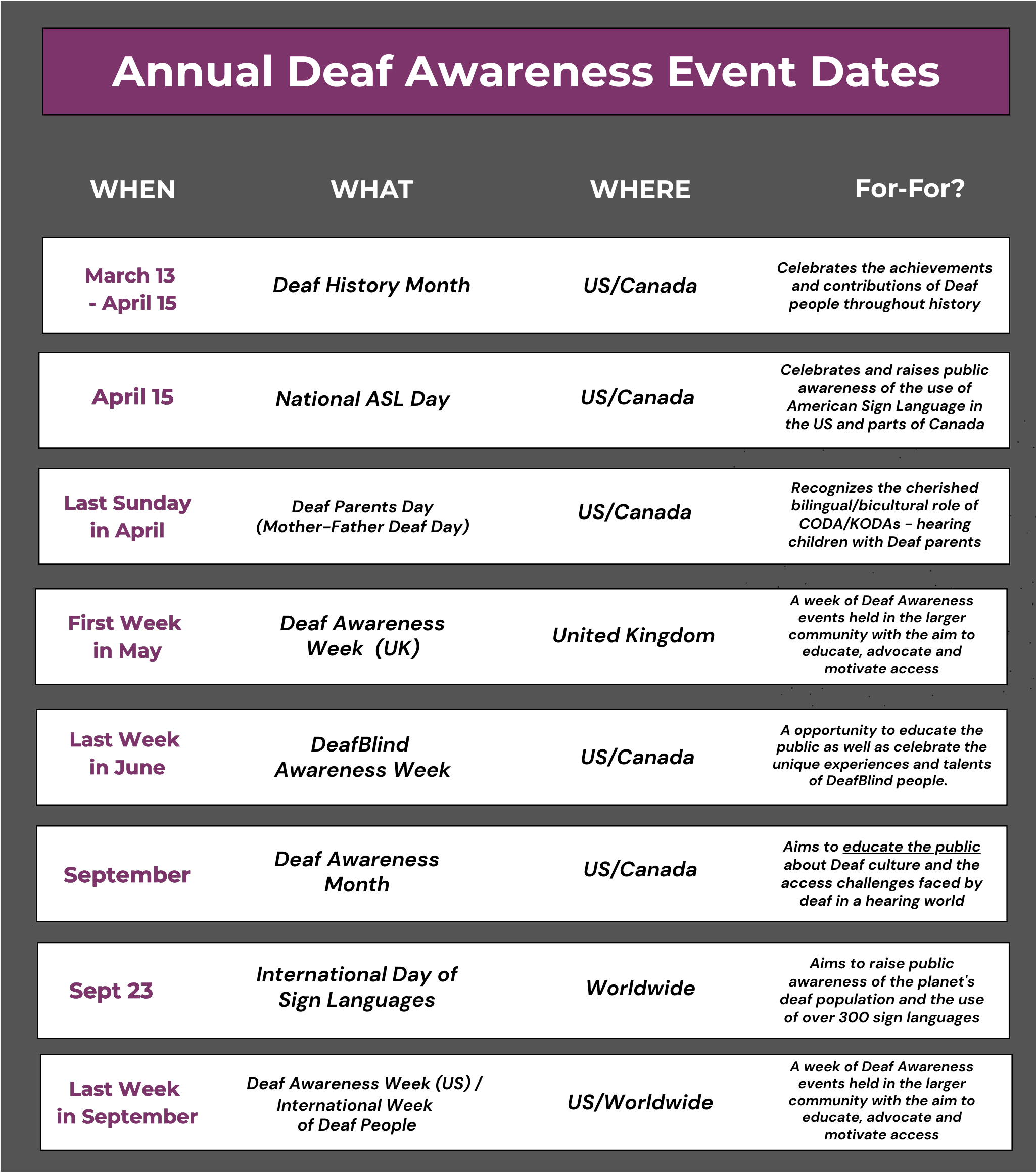
Deaf Awareness Month – September
September is Deaf Awareness Month and is celebrated each year. This is the biggie “Deaf Awareness” event most people know about in the US. From schools and organizations to local businesses, Deaf people are lifted up and recognized.
Deaf Awareness Month aims to educate the public about deaf culture and the challenges faced by deaf and hard-of-hearing individuals. This is different from Deaf History Month (March 13 – April 15) which celebrates the achievements and contributions of deaf people throughout history.
So, Deaf Awareness is now. Deaf History is … history.
International Day of Sign Languages – September 23rd
International Day of Sign Languages is commemorated on September 23rd worldwide. The goal is to raise public awareness to the plight of the planet’s deaf population. The World Federation for the Deaf estimates that more than 80% of the world’s 70 million deaf people live in developing countries, collectively using more than 300 different sign languages!
In 2017, the United Nations proclaimed September 23rd International Day of Sign Languages honoring the date the World Federation for the Deaf was established in 1951.
September 23rd also kicks off International Week of Deaf People which is celebrated internationally as well as Deaf Awareness Week in the United States.
Deaf Awareness Week / International Week of Deaf People – Last Week of September*
Deaf Awareness Week events are typically held during the last week of the month of September, capping off Deaf Awareness Month in the US. Deaf Awareness Week in the US coincides with the worldwide recognition of International Week of Deaf People.
*In the UK, Deaf Awareness Week is held during the first week of May.
Traditionally, Deaf Awareness events are opportunities for local businesses to make their goods and services already inclusive and accessible, without someone having to request services. It should be noted that most businesses are mandated to provide reasonable accommodations for accessibility upon request. Reasonable is the key word here because it’s not always feasible to provide an interpreter if it’s for an unplanned visit or if it’s for a nominal transaction.
During Deaf Awareness Week, businesses are rolling out the proverbial welcome mat to Deaf people so they can access things as easily as hearing people do. Each business takes a look at what they offer, filter out barriers a Deaf person might experience, and make adjustments to provide access.
For example, a tax preparation service might advertise they have secured interpreters all day for a certain date. A community theater secures interpreters for their current play performances. The neighborhood sports bar makes sure all the TVs have the captions turned on at all times.
Some folks might think getting a non-requested interpreter for an event is a little “above and beyond” in terms of providing access. From an economic standpoint, perhaps. But when you consider hearing people can walk into any establishment and have the same access that interpreter provides, it makes you think about how different life is when that’s constantly a consideration.
So when hearing people see Deaf people getting access with the fanfare, know it’s designed to show what access looks like. So every time you don’t see it thereafter, now you’ll know what no access looks like, too. This goes a long way in getting on the public radar for future inclusion.
Really, there’s no one-size-fits-all approach to raising awareness or and providing access to Deaf people. The most important aspect of Deaf Awareness events is the hearing community taking away something they didn’t know before. The best part if when they really absorb what they’ve been exposed to and put it to work in some way in their lives. That’s showing Deaf people they see us.
As a Deaf person, it’s always amazing to be seen.
Common Questions:
Why isn’t Better Hearing Month on this list? Do Deaf people recognize it?
While Better Hearing Month is commemorated in May in the US, the focus is on educating the hearing public on recognizing signs of hearing loss and hearing evaluation. This is a very important topic for adult hearing populations as they move through life because many people are impacted by it and need resources. While it’s a great movement, it really has nothing at all to do with Deaf culture or sign language. The fact is, most Deaf people who embrace the Deaf community as their own have been Deaf or hard of hearing either from birth or a very young age, so we’re pretty well-versed in hearing evaluations. Plus most hearing care professionals do not know ASL as their clients tend to be older adults experiencing hearing loss. So, Deaf Awareness and Better Hearing themes are best served as separate events. Apples and oranges, really.
I thought Deaf Parents Day was about being a Deaf parent, no?
Nope. Deaf Parents Day is about the kid/child’s experience growing up in such a unique subculture. Those kids have a bond, man. Not just with Deaf people, but specifically with each other. Historically, this was known as “Mother-Father Deaf Day” which is how kids would tell people that their parents are Deaf. I can’t even explain the pride I’ve seen in young and old CODA/KODA faces when they sign that. I guess, it’s that spark you see when someone really “gets” you. So this is a testament to that experience. They’re announcing who they are – with pride.
2 Responses
You should consider adding the day for those ppl that work in the deaf community ( ASL Teachers and Sign Language Interpreters. )
Hm, it’s true both teachers and interpreters have appreciation days. Deaf Awareness Days as listed in the article tend to celebrate Deaf people – our plight and history, which most people miss in the mainstream coverage we typically get. So, I really wanted to be very specific – especially since the dates get confusing, I wanted to clarify these. Thanks for the feedback. 🙂